


V2G Leaders Europe Summit 2025 Concludes with Clear Call for Action
Scale from Pilots to Multiparty, Interoperable, Bidirectional Charging Ecosystems
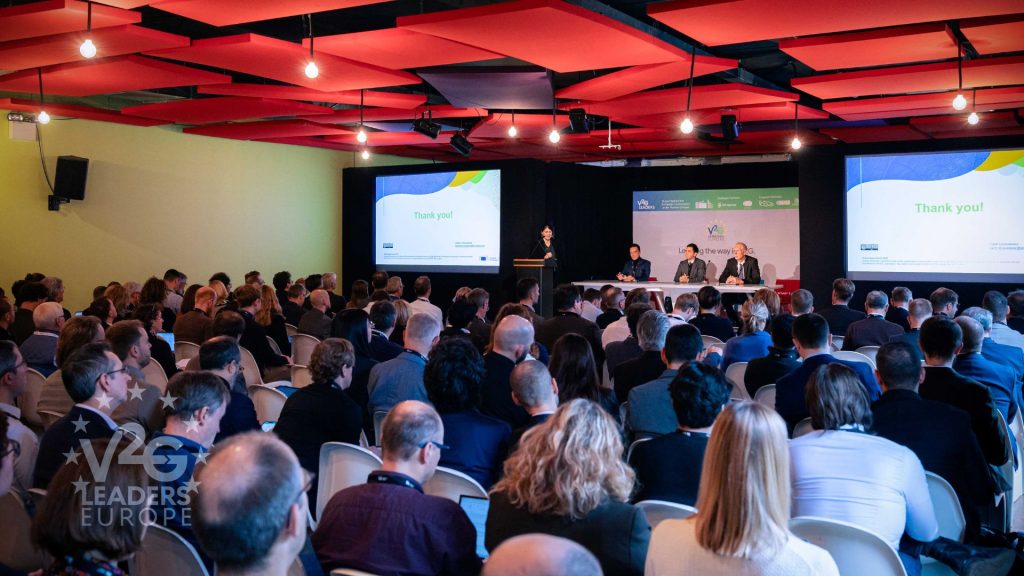
V2G Leaders Europe gathered over two hundred expert representatives from policy, research, industry, grid operations, standardization, and innovation ecosystems on 20 November 2025 in Brussels for its first Summit on the future of smart and bidirectional charging. The overarching message throughout plenaries, sessions and technical workshops was clear: Europe has the technological maturity, regulatory momentum and industrial capacity to lead on bidirectional charging. Discussion revealed that the time is ripe for creating a positive spine for the European Automotive Industry in times of increasing geopolitical conflicts
Brussels, 11 December 2025
A decisive signal from the European Commission
Opening interventions from DG ENER, DG RTD and DG CNECT underscored that V2G sits at the intersection of Europe’s climate, competitiveness and digital agendas.
- Mechthild Wörsdörfer (DG ENER) emphasized that electrification and renewables targets require EVs to function as flexible assets, not merely loads. She highlighted that V2G can support grid stability, reduce system costs and strengthen the Green Deal – but only with trustworthy data exchange, multiparty interoperability and coordinated implementation.
- Joanna Drake (DG RTD) pointed to Europe’s strong research base, urging the transition from pilots to commercially viable products and regulatory sandboxes as announced by the Automotive Action Plan. A Memorandum of Understanding recently signed by three Horizon Europe partnerships (2Zero, CCAM and BATT4EU) brings more cooperation, a shared vision and a clear path forward. Accelerating strategic innovation in the automotive domain.
- Thibaut Kleiner (DG CNECT) pointed out that a V2G strategy is seamlessly embedded into Europe’s Automotive Action Plan, fully aligned with actions linked to Europe’s digital and competitiveness strategy; notably highlighting that software-defined vehicles, open data spaces and sovereign digital platforms are essential for a competitive EV ecosystem capable of global leadership.
Throughout the agenda, Commission speakers across DG ENER, DG RTD, DG CNECT, DG MOVE and DG JRC reaffirmed V2G as an essential component of Europe’s energy-mobility-digital integration.
From proofs of concept to real-world deployment. The summit showcased concrete progress across Europe:
- France: The Mobility House and Renault operate a commercial V2G-AC service offering participating drivers “zero charging costs.”
- Finland: Virta aggregates EV fleets as part of a virtual power plant, using AI-driven forecasting to stabilize the grid.
- Netherlands: Utrecht has evolved from sandbox regulation to an open V2G market model.
- United Kingdom: With over 700 deployed bidirectional chargers and long-term flexibility targets, V2G is becoming integral to system planning.
These examples demonstrate that V2G is technically feasible and economically meaningful but so far only proprietary solutions are implemented around CCS – therefore scaling remains dependent on clear regulation, multiparty interoperable standards, viable business models and user-centered service design.
On the Road to Interoperability
Europe’s V2G rollout will only scale if vehicles, charging infrastructure, backends and distribution grids can communicate seamlessly and securely, both for AC and DC systems (and in future also for WPT). Speakers highlighted that ISO 15118-20 is the backbone for EV–EVSE communication, yet remaining bugs, grid-code gaps and the absence of clear cybersecurity requirements still slow commercialization.
Task 53, represented by Operating Agent Marco Piffaretti, outlined a global consensus effort involving six specialized laboratories across three continents and more than forty industry partners. Its roadmap focuses on closing gaps in standards, aligning minimum ISO15118-20 and grid-code requirements, preparing multiparty EV-OEM, EVSE-manufacturers and DSO testing and coordinating industry agreement through 2028. Professor Henrik Madsen (DTU) reinforced the operational perspective, noting that DSOs with high EV penetration already offer more dynamic tariff and flexibility mechanisms to integrate bidirectional charging efficiently.
A panel on Open Source gave concrete examples of cooperation between OS and standardisation in the e-mobility sector, while hinting at ongoing work of involving open source communities like LINUX project EVEREST into formal standardisation processes. While delivering the Code for the Standard, communities can contribute to more agility in the standardisation development processes to respond adequately to faster innovation cycles.
Representatives from Ampère, E.DSO and DEKRA stressed that multiparty interoperable, certifiable implementations are essential for scale-up, grid operators’ trust and prototype testing. Moderated by Harald Scholz (DG JRC), the panel converged on a clear message: multiparty interoperability is now the strategic prerequisite for a competitive European V2G industry.
What hurdles still exist for commercial rollout?
The session on commercialization highlighted that V2G can only scale, once technology readiness, viable economics and clear market access align. Based on a recent position paper by ACEA, panelists stressed the need for a secure data exchange and control interface via a data mediations platform as essential for predictable, standardized energy services across OEMs, CPOs and aggregators. EDF DREEV showed that coordinated fleet deployments – now moving from CHAdeMO to CCS – demonstrate interoperable architectures and controlled cycling strategies that limit battery ageing.
Other automotive OEMs underlined that today’s tariff structures and tax regimes still undermine the business case, although today vehicle-to-home already has the potential of quick gains with immediate cost benefits for electricity consumers; with successful business cases having been introduced by several energy aggregators. As pointed out, success depends on customer trust, scalable digital platforms and improved flexibility-market access as precursors for mass-market V2G participation. Insights from the XL-Connect project showed strong technical progress – including ISO 15118-20 chargers and real-world microgrid demonstrations – yet user acceptance, hardware cost reductions and clear compensation models remain hurdles in adoption.
Outlook 2026
In the closing remarks, the Commission underlined the imperative of building consensus across several V2X initiatives through its Digital4Energy expert group and named the Sustainable Transport Forum as well as the Coalition of the Willing for Bidirectional Charging. The strong enthusiasm and constructive spirit expressed throughout the Summit demonstrated a rapidly maturing and increasingly agile ecosystem, and the appetite to lead the way globally. Building on this momentum, the Commission highlighted the pivotal role of coordinated governance, digital trust frameworks and cross-domain interoperability standards in securing Europe’s competitive edge. Together with Task 53’s Operating Agent Marco Piffaretti, who concluded the Summit with a clear call to seize the window of opportunity beyond 2026; it was emphasized that V2G success depends largely on minimal but mature multiparty interoperability and standards interfaces, supported by a well-defined and reproducible testing and validation framework.
Europe’s pole position will only be maintained if all actors – OEMs, infrastructure providers, DSOs, aggregators, software innovators, regulators and policymakers – accelerate the transition from alignment on interfaces and standards towards implementation. Their joint message echoed throughout the room: the foundations are now in place, the community is mobilized, and Europe has a unique chance to scale a multiparty-interoperable, secure and user-centered bidirectional charging ecosystem – provided it acts with urgency and unity.
V2G Leaders Europe has presented itself as a truly European dedicated platform for policymakers, OEMs, utilities, digital innovators and research institutions leading the way in V2G. The next edition will be held in November 2026 in Brussels.