


Understanding the CEI Ecosystem via the Hourglass Model
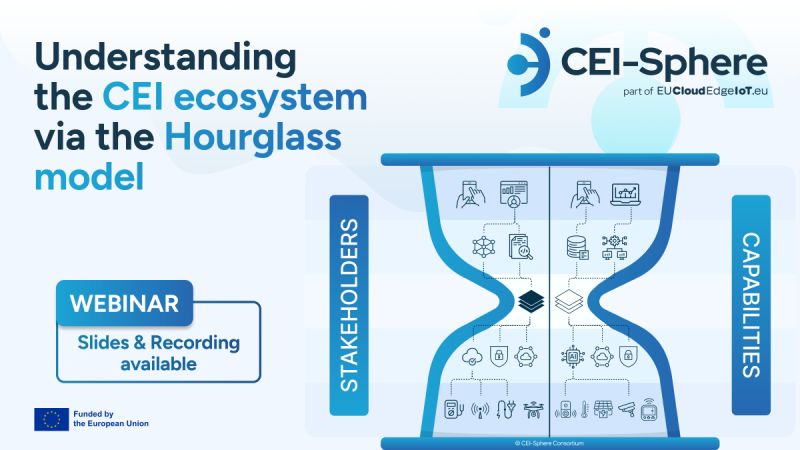
Making sense of complexity: the CEI-Sphere Hourglass Model
On the first week of January, CEI-Sphere held a webinar “Understanding the CEI ecosystem via Hourglass Model” to explain Europe’s Cloud-Edge-IoT (CEI) ecosystem. Multiple stakeholders, overlapping standards, evolving regulations, and fast-moving technologies often make it difficult to see how everything fits together.
A visual framework that turns complexity into clarity, and fragmentation into structured dialogue.
As Damir Filipovic, our Managing Consultant mentioned, the Hourglass Model is far more than a conceptual exercise, it is a core element of the project’s “backbone toolkit”, designed to support open edge ecosystems and enable the market scalability of Cloud-Edge-IoT solutions.
The model provides a practical way to navigate complexity without losing coherence, as regulations, standards, technologies and open-source solutions evolve, so too does the model
As Maria Giuffrida (Trust-IT) said, “the Hourglass Model acts as a strategic canvas to map the critical relationships between stakeholders, technological capabilities, governing standards, and open-source implementations”.
The Hourglass Model reinvents a concept previously used to explain how the internet and Linux ecosystems scaled successfully.
- At the bottom, diverse infrastructure components generate data.
- At the top, applications transform that data into value.
- In between lies a narrow layer where interoperability happens, and where focused effort can unlock scale, innovation and market integration.
Inside the Hourglass
The CEI-Sphere Hourglass Model is built around two complementary dimensions that make it both comprehensive and intuitive. A vertical view (from infrastructure to applications) that represents the flow of value through the ecosystem; and four horizontal elements that bring context: stakeholders, capabilities, standards and implementations & open source. Together, these axes turn the model into a shared reference point for technical, business, and policy discussions.
A proven model
One of the Hourglass Model’s strengths is its versatility, it has been applied across multiple real-world contexts, each time revealing new insights.
- The EU Joint Research Centre applied the Hourglass Model to its Code of Conduct for Energy Smart Appliances, particularly EV chargers:
- Phase 1 focused on enabling interoperability for energy flexibility exchange while remaining technology-neutral
- Phase 2 expands protocol support, increases device coverage, and enables Vehicle-to-Grid (V2G) services.
The model clearly links stakeholders (appliance manufacturers, energy utilities, and policymakers) to capabilities like grid stability and consent management, and to standards.
- Javier Valiño from the Eclipse Foundation, explained how the company has also adopted the Hourglass Model its data spaces initiative, driven by interoperability requirements under the EU Data Act. Here, the narrow layer represents trusted data sharing and interoperability protocols, interoperability is achieved through a layered, open-source protocol stack, including base protocols for data exchange, bindings to wire protocols, claims protocols for identity and machine-readable policy and credential profiles.
- Ignacio Lacalle Ubeda showed how for the O-CEI project, which aims to create a “digital backbone for energy flexibility,” the Hourglass Model plays three distinct roles: global project mapping across the energy value chain, value-chain characterisation for specific pilots, creation of replicable blueprints for real-world deployment. For example, in the “Energy flexibility and optimisation for EV charging” blueprint, the model maps concrete technologies and standards directly to infrastructure and capability layers, providing a reusable guide for implementation.
Across all these applications, one message stands out clearly: the Hourglass Model is not static, it is a dynamic tool for communication, collaboration, and strategic alignment.
Why it works
- Bridges stakeholders, creating a common language between business, technical, and policy communities
- Acts as an ecosystem canvas, revisited and refined as projects evolve
- Focuses impact, especially in complex EU initiatives that risk spreading effort too thin
- Embraces evolution, with future iterations expected as technology and policy landscapes change
In short, it helps match the “demand side” with the “supply side” of innovation.