


Skills for Europe’s AI future
Europe’s ambition to lead in artificial intelligence is bold, necessary and widely shared. But as highlighted in the recent “AI Skills” webinar, co-hosted by LEADSx2030 and AiSECRETT, achieving a thriving European AI ecosystem is not simply a matter of deploying more technology, it’s also a human challenge.
The webinar aimed to explore and address the human and skills-related challenges of building a thriving European AI ecosystem. Across the session, speakers made one thing clear: Europe’s AI future depends on how well it educates, retrains and empowers its people.
Europe’s digital skills reality check
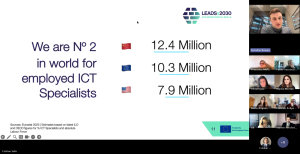
Opening the webinar, Brendan Rowan, our managing consultant and coordinator of LEADSx2030 set the scene with a data-driven overview of Europe’s ICT workforce. Since 2011, the EU has nearly doubled its ICT workforce, making it the second largest globally. Yet under the Digital Decade targets, Europe aims to reach 20 million ICT specialists by 2030 a goal that, at the current pace, would not be met until 2051.
Today, ICT specialists represent just 5% of the European workforce, only halfway to the target.
One of the most striking insights was where digital skills are actually used. Only half of ICT specialists work in the ICT sector itself. The rest are embedded across the economy, including: manufacturing, professional services, manufacturing, professional services, finance and insurance, wholesale and retail. This underlines a crucial point: AI and digital skills are foundational across all sectors.
Rowan also highlighted a persistent and troubling imbalance in Europe’s digital workforce. At the current rate of change, Europe will not reach its target of 40% women in digital roles until 2087. Over the past decade, the share of women in digital roles has increased from 16.5% to 19.5%. Yet the message was not pessimistic, with focused action, Europe has a clear opportunity to unlock talent, innovation and resilience by accelerating women’s participation in digital and AI roles.
The challenge Europe faces is no longer just a skills shortage, it is a workforce replacement cycle. By 2035, Europe will need 4.2 million ICT professionals simply to maintain its current position. Of these: 1.7 million are required for net growth and 2.5 million are needed to replace professionals leaving through retirement or career change.
It’s not occupation versus occupation anymore: data shows demand is rising at senior levels, valuing experience above all.
AiSECRETT: rethinking AI
Pablo Francisco Rausell Koster introduced AiSECRETT, a project that challenges how AI itself is understood. He noted that AI is everywhere, but it is often misunderstood, it is not neutral, it shapes power and value.
Rather than treating AI as a simple tool, AiSECRETT frames it as a system of governance, one that mediates knowledge, rights and decision-making, central to this vision is European digital sovereignty.
AiSECRETT’s approach is guided by the Triple Transition, where digital, green and social transformations evolve together. The project also explores creative and ethical uses of AI through a new Master’s degree in AI for Creativity and the Triple Transition, designed to equip professionals to generate human, social and environmental value.
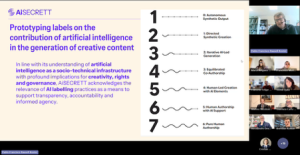
Transparency plays a key role too. AiSECRETT is prototyping AI contribution labels, indicating how much AI is involved in content creation on a scale from one to seven. Koster encouraged participants to embrace depth, openness, locality, honesty and governance as core principles of AI education.
AI4Gov-X: building AI capacity
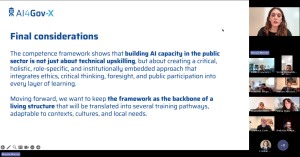
AI skills are not only needed in industry, Gianluca Misuraca and Marzia Mortati presented AI4Gov-X, a European knowledge hub focused on AI adoption in the public sector. The initiative delivers modular, multilingual training for professionals in AI, data science and digital governance, supported by a micro-credential certification system.
AI4Gov-X moves away from fragmented, short-term courses, offering instead structured and progressive learning that integrates: technical knowledge, practical skills and public values. The goal is to empower public sector professionals to manage digital transformation responsibly and use AI to create genuine public value.
EMAI4EU: education and market needs in Emotion AI
Finally, Vilma Djala, Education Lead at 28DIGTAL, introduced EMAI4EU, which tackles Europe’s skills gap in Affective Computing, also known as Emotion AI.
The project offers a double-degree Master’s programme with a specialisation in Emotion AI, alongside modular options for upskilling and reskilling professionals. What sets EMAI4EU apart is its evidence-based “backward design” approach: market needs are identified first, translated into measurable learning outcomes, and only then used to shape curricula.
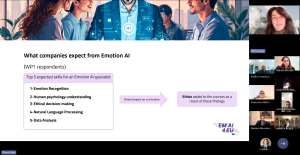
Industry partners highlighted a mismatch between the widespread use of basic AI tools and the advanced skills required for strategic implementation. The most in-demand competencies include: emotion recognition, understanding human psychology, ethical decision-making, natural language processing and data analysis.
What does this mean for Europe’s AI future?
Across all three initiatives, a shared vision emerged. Europe’s AI strategy is shifting decisively towards hybrid competencies, combining technical excellence with ethics, governance and human-centred design. Education must be market-driven, evidence-based and values-led, ensuring graduates are ready not just to deploy AI, but to shape it responsibly.
Europe’s success in AI will depend on cultivating professionals who are skilled, ethically aware and adaptable, capable of driving innovation while strengthening society and safeguarding digital sovereignty.