


Mapping the future of Europe’s ICT workforce
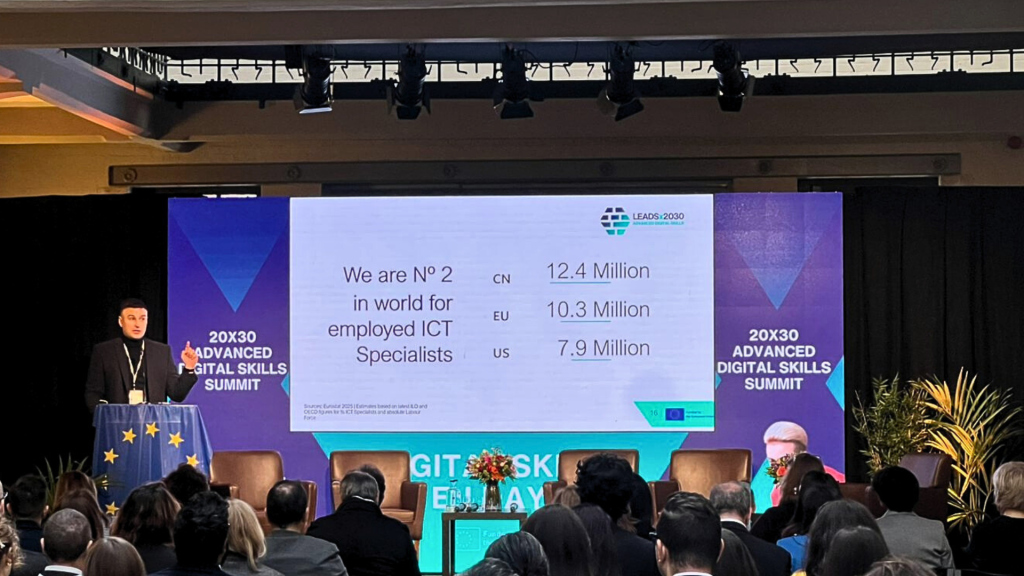
At the 20×30 Advanced Digital Skills Summit, hosted on the 13th of November, our managing consultant Brendan Rowan presented the ADS State-of-Play report.
The conversations about the future of technology often focus on talent shortage and AI, but the full picture of Europe’s digital future is more nuanced and encouraging.
Progress toward the 2030 goal
Europe has set an ambitious goal: to have 20 million ICT specialists by 2030, representing 10% of the total workforce. Since 2011, Europe has doubled its ICT workforce, closed the talent gap with the United States, and now boasts the second-largest number of ICT specialists in the world: progress looks impressive. However, at the current rate of progress, the 20 million specialist goal will not be met until 2051.
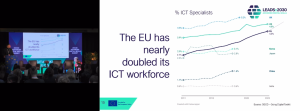
Today, ICT specialists make up only 5% of the European workforce, halfway to the target. The data reveals a fact about where tech talent actually works: only 50% of ICT specialists are employed in the ICT sector itself. The other 50% are distributed across the wider economy in sectors including: manufacturing, professional services, finance & insurance and wholesale & retail.
This distribution proves that technology is no longer confined to a single industry, instead, it has become a horizontal capability layer that embeds digital expertise into every type of business and fundamentally changes where value is created.
AI’s real target isn’t your job
Contrary to the narrative that AI will replace programmers, job advert data shows that demand for programming skills is remaining strong. However, job adverts often reflect the market of 9 to 12 months ago, meaning a shift may already be underway but not yet visible.
The more immediate and profound impact of AI is not occupational, but generational. The latest hiring data from the US reveals a complete collapse in hiring for entry-level software developers since 2022. Simultaneously, demand for experienced professionals in their late 30s and early 40s continues to grow.
This shift indicates that companies are no longer investing in training junior talent; they are “buying experience”.
Advancing gender parity in digital roles
The data on gender diversity in technology is fundamental, at the current pace of change, the goal of reaching 40% women in digital roles will not be achieved until the year 2087.
Over the last 10 years, the share of women in digital roles has only inched forward from 16.5% to 19.5%. With focused initiatives and inclusive policies, Europe can accelerate the inclusion of women in digital roles, creating a stronger, more innovative workforce.
The real issue is no longer a simple shortage, but a massive workforce replacement cycle. By 2035, Europe will need 4.2 million ICT professionals to maintain its current position. Of those, only 1.7 million are for net new growth; 2.5 million are needed simply to replace professionals lost to retirement and career changes.
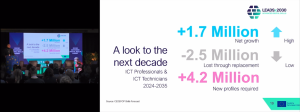
This reframes the problem entirely. The focus cannot just be on filling new jobs, but on the efficiency of training and retaining talent. Here, there is a silver lining: investing in the tech workforce is remarkably effective. In fact, ICT has the lowest replacement need of any occupation in the EU.
For ICT professionals, for every 1,000 we need net, we need to train or attract 2,460. For health professionals for every 1,000 we gain, we need to train more than 5,000.

This data shows that every investment in tech talent provides a powerful return. The challenge is not that our training is inefficient, but that we are facing a massive demographic turnover, to overcome this we need to cultivate diversity and open the door at entry-level talent.
Navigating the future of European technologies
Europe’s tech labour market is complex, but it is also full of opportunities. The future of innovation relies not just on filling jobs, but on nurturing talent, embracing diversity, and leveraging technology to elevate every industry. By focusing on these strategic priorities, Europe can transform perceived challenges into catalysts for growth, creating a dynamic, resilient digital ecosystem for decades to come.
Take the first step towards strategic success, connect with us now!