


Connecting Women in Digital: mapping progress across Europe
Women’s participation in the digital economy has long been a topic of both opportunity and challenge. While strides have been made in education and careers, gender gaps remain persistent across Europe and beyond. The Women in Digital (WiD) Index provides a clear data-driven lens on where women thrive and where more support is needed.
The WiD Index tracks female participation in ICT education and careers, benchmarking all 27 EU Member States and global peers such as Brazil, the UK, India, and the USA. It captures women’s journey through five key phases of the pipeline:
- STEM education: building foundational knowledge in science, technology, engineering and maths
- ICT education: higher education and vocational training that prepare women for digital careers
- Digital careers: early-to-mid-career employment, training and progression
- Leadership: senior roles and executive positions within ICT
- Enabling environment: societal and structural factors shaping women’s opportunities
By mapping every phase, from classroom to boardroom, it’s possible to see not just where women succeed, but where the system lets them slip through.
The WiD Index follows a four-step methodology to ensure quality and comparability:
- Data collection: combining Eurostat, OECD PISA, EIGE data, and the 2025 Women in Digital survey (4,454 respondents)
- Normalisation: converting all metrics to a 0-100 scale, inverting where lower values are better (e.g., gender pay gap)
- Weighted aggregation: combining phase scores according to assigned weights Digital (35%), ICT (25%), STEM (20%), Leadership (10%), Enabling environment (10%)
- Validation and quality control: cross-validation with known country patterns and sensitivity analysis
Key findings
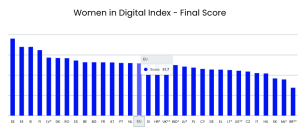
The EU average final score is 51.7, but performance varies considerably across countries and phases. Among the top performers, Sweden leads the way with an overall score of 76.2, followed by Estonia and Ireland, both scoring 68.0. Finland comes next with 64.8, and Latvia rounds out the leading group with a score of 57.4.
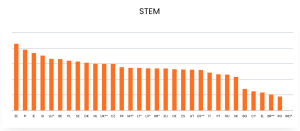
- Girls generally perform well in STEM subjects at school, but participation in advanced ICT studies is uneven.
- Retention and progression in digital roles remain critical barriers, highlighting the importance of continuous training and supportive workplace policies.
- Women are underrepresented in senior ICT roles, often citing structural barriers such as work-life balance and limited access to career-advancing opportunities.
- Countries with strong enabling environments, including national initiatives and equitable digital skills training, tend to see better female participation across the pipeline.
Data-driven insights are the first step to meaningful change. The WiD Index, provides a clear map of where to act and how to accelerate women’s digital careers. Support for women must span every stage of the pipeline, from STEM education to executive leadership, to build a truly inclusive digital economy.
Explore the online interactive dashboard here: https://index.widigital.eu/index/