


Connecting Women in Digital: how is Europe taking action?
Across Europe, the digital economy is transforming at pace but women are still underrepresented in ICT and related STEM fields. The Connecting Women in Digital (WIDCON) initiative, funded by the European Commission, aims to change that narrative.
During the “Understanding national actions on women in digital cross Europe” webinar, organised by Connecting Women in Digital, Simona Ramanauskaitė from the Vilnius Gediminas Technical University, and our consultant Cristina Ciobica, explored the latest findings from WIDCON’s national actions analysis and its complementary assessment tool, the Women in Digital (WiD) Index. Together, these resources paint the clearest picture yet of how Europe is tackling the digital gender gap.
Progress varies dramatically from one Member State to the next. Some countries have made gender equality in digital a national priority, others are only just beginning to invest. The WIDCON project is aligned with the broader EU economic growth and innovation strategy, the initiative identifies two critical drivers for closing the gender gap in digital fields:
- Economic urgency: Europe faces a shortage of ICT and STEM professionals. Bringing more women into digital careers is essential to maintaining innovation and competitiveness.
- Social value: strengthening gender equality in digital aligns with core EU values and supports a more inclusive society.
To succeed, every Member State plays a vital role, from shaping education pathways to addressing unique regional challenges, to utilise funding as a signal of prioritisation for gender equality.
How Europe’s commitment was measured
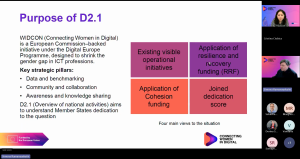
To assess national dedication to the question, three main data sources have been selected:
- Internet research: to identify visible operational initiatives.
- The RRF Scoreboard: tracking funds from the Recovery and Resilience Facility.
- The Kohesio system: analysing Cohesion Fund allocations.
Machine Learning models helped classify initiatives across themes, ensuring a consistent and accurate assessment. The research mapped initiatives across four phases of the “WiD Lead Pipeline”: STEM, ICT, Digital, and Leadership. Across all phases, European initiatives far outnumber global and non-European efforts. For example:
- Digital and ICT phases are by far the most active within Europe.
- Leadership has the fewest initiatives signalling a persistent gap in advancing women into senior digital roles.
- Country-level initiatives dominate, showing that national action (rather than broad EU-level programmes) is the engine of progress.
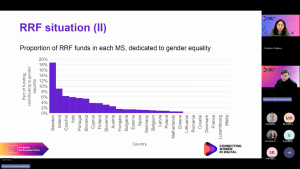
The RRF analysis measured the proportion of granted funds contributing to gender equality. Sweden (nearly 19%) and Ireland (approx. 9%) allocate the highest percentage of their RRF funding toward gender equality. However, several countries including Lithuania, Romania, Croatia, and Denmark register 0% dedicated funding in this context.
RRF spending touches four social categories:
- Education and childcare
- Employment and skills
- Health and long-term care
- Social policies
The Cohesion Fund analysis focused on three layers: total budget, portion for the “Gender Equality” category, and projects specifically related to “Women in Digital.” Austria, Czechia, and Greece dedicate the highest share of their budgets to the gender equality category. But projects specifically related to Women in Digital make up less than 1% of total Cohesion allocations in most Member States.
Europe’s leaders and cautious players
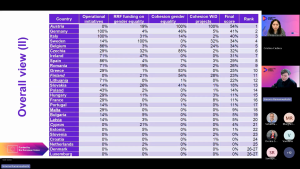
To offer a holistic view of the commitment, a weighted score was calculated based on four metrics: National Operational Initiatives (30%), RRF Funding for Gender Equality (20%), Cohesion Fund for Gender Equality (20%), Cohesion Fund for Women in Digital Projects (30%). The top three states are Austria, Germany and Italy, while countries such as Slovenia, Croatia, and the Netherlands ranked at the bottom of the list with scores of 0%, reflecting minimal visible commitment to Women in Digital initiatives.
Complementing the Picture: the Women in Digital (WiD) Index and the Annual Report
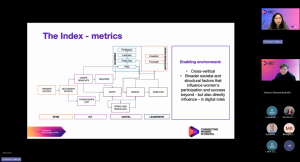
The Women in Digital Index offers a broader monitoring framework. This Index assesses how girls and women move through the digital pipeline and identifies “leaky pipeline” points where they may exit the sector. It covers 27 EU member states and four benchmarking countries (the UK, the USA, Brazil, and India) and combines primary data from the 2025 Women in Digital survey, and secondary data from Eurostat, OECD, ILOSTAT, EIGE, World Bank, and national bodies.
A key component is the Enabling Environment, which tracks structural and societal factors influencing women’s success in digital roles.
Every year, WIDCON publishes a comprehensive Annual Report that blends quantitative rankings, qualitative insights from Thematic Working Groups and findings from national actions and the WiD survey. This report acts as a decision-support tool, enabling stakeholders to:
- Target specific “leaky pipeline” stages
- Identify success models across Member States
- Monitor progress over time
Progress with clear gaps and a path forward
Europe is taking meaningful steps to close the digital gender gap, but the landscape is uneven. Some countries are investing heavily and building robust pipelines, while others have barely begun. Yet the tools now in place offer clarity, with stronger data, visible benchmarks, and growing collaboration, Member States have the insight they need to accelerate progress.